
New Delhi: Amid slogans of “we want justice”, hundreds of Delhi Police personnel on Tuesday staged an unprecedented protest against assault on their colleagues by lawyers at the Tis Hazari court on Saturday, prompting Police Commissioner Amulya Patnaik to come out and issue statement of assurance of a “fair probe”.
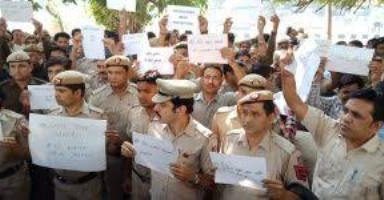
As the policemen, carrying placards, raised slogans for hours outside the Police Headquarters at ITO, Patnaik finally stepped out and told them that it was “testing times for us”.
He urged the policemen to join back their duties and maintain peace.
A minor argument between a lawyer and some policemen over parking at the Tis Hazari court complex on Saturday flared up, leading to violence and arson. A lawyer was left with a bullet injury.
“Twenty policemen, including one Additional DCP and two SHOs, sustained injuries. Eight advocates were also hurt. 12 motorcycles, one police QRT gypsy and eight jail vans were damaged,” the police had claimed.
Meanwhile, the Delhi Police has submitted a report to the Ministry of Home Affairs on the violence at Tis Hazari court premises.
The Ministry, which directly controls Delhi Police, had sought the report from the Delhi Police just a day after the violent clashes.
A five-minute audio tape of a policeman, who was seriously injured in Saturday’s violent clashes at Tis Hazari courts, has revealed that the lady Deputy Commissioner of Police (DCP) present on the spot was allegedly abused and roughed up by the lawyers and a desperate attempt was made to snatch away her PSO’s service revolver.
While the PSO (Personal Security Officer called ‘Operator’ in Delhi police) was thrashed with iron chains and lay unconscious on the floor, the lady DCP, Monika Bhardwaj, broke down on Sunday and wept for quite some time, the audio clip revealed.
On the other hand, faced with bad press after another video emerged of a lawyer slapping a policeman outside the Saket Court, the Bar Council of India (BCI) on Tuesday recalled its Coordination Committee resolution that asked lawyers to abstain from work. The BCI has appealed advocates to resume work from Tuesday.
In a letter to the lawyers, the Council said, “…the resolution of Coordination Committee (that police officials or personnel should be arrested first) is now meaningless and has no legal basis. We are to think this important aspect from the legal point of view, so that we don’t become a laughing stock before the society.”
The letter comes as a reprieve to thousands of litigants across Delhi, who have suffered since Monday as the courts in the city remain shut and lawyers abstain from work after the Delhi High Court ordered a judicial inquiry into the violence between lawyers and policemen at the Tis Hazari court on Saturday.
A minor argument between a lawyer and some policemen over parking at the Tis Hazari court complex had flared up leading to violence and arson, in which a lawyer received a bullet injury. “Twenty cops, including one Additional DCP and two SHOs, sustained injuries. Eight advocates were also hurt. Twelve motorcycles, one police QRT Gypsy and eight jail vans were damaged,” the police claimed.
But on Tuesday after hundreds of policemen gheraoed the Delhi Police headquarters demanding action against lawyers, many of whom have been found indulging in violence, public mood suddenly seemed turning against the legal fraternity.
In a climbdown soon after, the Council said: “Hooliganism and violence has no place in the Bar. The leaders will have to stop it immediately” and urged the lawyers to join back work.
It said CCTV footage and videos were being widely circulated with a motive to “malign” the image of lawyers and “implicate some lawyers”, and expressed apprehension that such material may be provided as evidence against the lawyers to the “Investigation Committee, the CBI, the Vigilance, the Intelligence Bureau and the High Court”.