
Shimla: A new trend in apple cultivation has emerged in Himachal Pradesh — apples are being grown in sparsely vegetative areas at higher altitudes such as Lahaul and Spiti valley, courtsey climate Change.
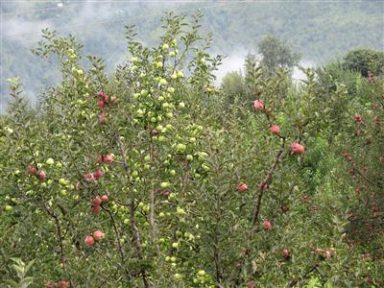
Fruit production industry in hilly zones is seeing a rise in temperature. Because of this, production of apple has moved to higher altitudes, which earlier were not suitable for this fruit.
A study conducted by the Regional Centre, National Afforestation and Eco-development Board and Dr Y.S. Parmar University of Horticulture and Forestry, Himachal Pradesh, points out that the rising temperature in Himachal due to climate change has driven the shift.
The study says that apple growing belt in low-lying valley areas like Kullu — once considered good for apple production — has now become extremely marginal, resulting in diversification to other fruits like kiwi and pomegranate, and vegetable seed production.
“The snow line once considered as ‘white manure’ for the apple crop and forest cover necessary for conservation and recharge of natural water bodies has also shifted upward to higher hills. Therefore, the quality apple production has shifted to higher hills and dry temperate zones of Kinnaur and Spiti areas,” the study says.
It said that the drier and warmer weather will ultimately result in a shorter growing season and lesser crop yields.
Himachal Pradesh has been divided in four zones on the basis of agro-climatic conditions. Zone I comprises low hills sub-tropical zone up to 1,100 metres, Zone II of mid hills sub-humid zone (1,100 to less than 2,000 m), Zone III of high hills temperate wet zone (2,000 to less than 3,000 m), and Zone IV the high hills temperate dry zone (above 3,000 m).
According to National Horticulture Board, apple can be grown at altitudes 1,500-2,700 m above sea level in the Himalayan range which experience 1,000-1,500 hours of chilling (when temperature remains at or below 7 degrees Celsius each season). The temperature during the growing season should be around 21-24 degrees Celsius.
Planting is usually done in the month of January and February. Loamy soils, rich in organic matter and having proper drainage and aeration are suitable for cultivation.
For optimum growth and fruiting, apple trees need 100-125 cm of annual rainfall, evenly distributed during the growing season. Excessive rain and fog near the fruit maturity period result in poor fruit quality with improper colour development and fungal spots on its surface.
Apple constitutes about 49 per cent of the total area under fruit crops. In Himachal, apple is mainly cultivated in the districts of Kinnaur, Kullu, Shimla, Mandi, Chamba and some parts of Sirmaur.
Himachal Pradesh Additional Chief Secretary Tarun Sridhar says that erratic weather patterns are now often seen affecting the apple production in Shimla and other districts.
“Several progressive farmers of the state are now opting for industrial crops such as mushrooms, flowers, off-season vegetables, mostly because of climate change,” Sridhar told IANS.
He says that due to climate change the use of pesticides, insecticides and chemical fertilisers has drastically increased and new crop diseases are coming up. He said December and January snow months were often going dry.