
New Delhi: Acclaimed writer Nayantara Sahgal was presented a Lifetime Achievement Award at a literature festival here. A member of the Nehru-Gandhi family and a constant face in the protest against the alleged intolerance in the country, she fired a series of salvos at the ruling dispensation, even saying that the Narendra Modi led NDA government is “a fascist regime” practising an undeclared dictatorship.
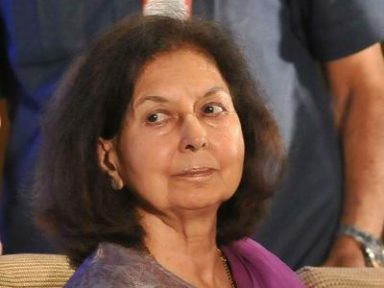
It is the duty of any leadership to bring the best out of its people. But the present leadership has made sure to bring the worst out of its people. They are deliberately taking no action against the mob,” Sahgal said on the opening day of the Times Lit Fest.
The writer of the immensely popular novel “Rich Like Us,” which won the Sahitya Akademi Award in 1986, further added that for thousands of years, the Indian civilization has stood for dissent and argument.
“I would like to point out that dissent is no longer the right word. It is not intolerance to threaten and kill those you disagree with. It is murder. We rejected a religious identity at the time of independence despite being very religious people. We chose to be secular because every religion could have its pride of place in India. I am afraid it is no longer so.
“We are under an undeclared dictatorship. Because people who disagree with the ideology of the establishment are threatened and murdered. There is a huge population out there living in constant fear. They are Muslims and Dalits. I want you to remember that we are living in times when Indians are killing Indians. And since they have ordered us not to speak, we are ensuring that we speak out loud at every chance that we get,” Sahgal added.
In the context of the ongoing controversy around Sanjay Leela Bhansali’s film “Padmavati,” whose release has been postponed in view of the raging protests, Sahgal said that it would be “the defeat for Indian democracy” if the movie wasn’t allowed to release.
“I don’t think banning of books or movies should have a place in our society. If we were worried about hurting people’s sentiments then we would still be burning widows. Sati would have never been abolished if we cared for what the sentiments of people were. If a sentiment is wrong then it must be hurt.
“Art and literature are not bound by sentiments. We have 1.5 billion people and we have that many sentiments,” she maintained.
She went on to remind the audience here that when Salman Rushdie’s “The Satanic Verses” was being banned, she wrote to then Prime Minsiter Rajiv Gandhi, urging him not to ban the book. But ultimately her advise was not taken and the book was banned.
She also recalled that she wrote a letter to the Sahitya Akademi during the emergency imposed by former Prime Minsiter Indira Gandhi, asking it to condemn censorship.
“Indira Gandhi was a democrat gone wrong. The present dispensation is a fascist regime. Do not forget that even (Adolf) Hitler was elected by the people.